


On September 16, 2025, the final day of the Immigrant Integration Convening at Fordham’s Lincoln Center campus, the Initiative on Migrants, Migration, and Human Dignity hosted a powerful panel, “Eyeing the Public Policy Landscape: The Current State of Affairs.” Leading experts in migration policy gathered to critically assess recent policy shifts and their profound impact on migrant communities.
The conversation, moderated by Fordham’s Dr. Christina Greer from the Department of Political Science, featured a distinguished panel: Dylan Corbett from the Hope Border Institute, Melanie Nezer of the Women’s Refugee Commission, Murad Awawdeh of the New York Immigration Coalition, and Cecilie Kern of the Mercy International Association.
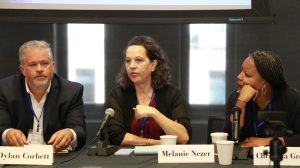
Dylan Corbett, Melanie Nezer and Christina Greer
The panel opened with a discussion of the recent dramatic shift in migration policy. Dylan Corbett described how communities at the border continue to feel the effects of policies that fail to recognize human dignity. Corbett said, “There’s a denial of human suffering and a denial of our responsibility before that suffering.” Despite this, he stressed that “border communities continue to be resilient. Every day, people choose to be neighbors to one another.”
Melanie Nezer offered a sharp critique of current policy, asserting “nothing this administration is doing is about safety and security. It’s about cruelty. It’s about creating more chaos, pushing people further into the shadows.” Her remarks drew attention to how fear-based narratives actively create the conditions in which migrants are forced to live.
Murad Awawdeh, a graduate of Fordham’s School of Professional and Continuing Studies, spoke about the pressures faced by local organizations that support immigrant communities in New York. He said that political discourse has reached a point where “we have mainstreamed inhumanity to the level I thought we would never get to.”
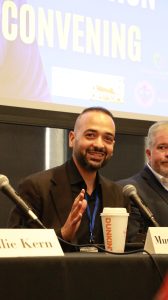
Murad Awawdeh, CEO of the New York Immigration Coalition.
Despite this, Awawdeh, speaking from his experience with the New York Immigration Coalition, asserted that his hope remains rooted in relentless community action. He acknowledged the difficulty, saying, “every day is a new crisis, a new challenge.” But he concluded, “What gives me hope is the people who actually stand up to address those challenges. Acts of joy are acts of resistance too.”
Cecile Kern brought a global perspective from her work at the United Nations in coalition with Catholic institutions. She explained, “At the UN, we strive to be a moral voice standing in solidarity with the most vulnerable and echoing the call to leave no one behind.” Kern described how international advocacy is critical to counter the “pervasive dehumanization and criminalization faced by migrant communities.”
In closing, Dr. Greer spoke about the importance of youth leadership in civic life. She noted, “Young people continuously hold the key to many of the answers to the issues that we face. We saw it during the civil rights movement, and we’re going to see it again.”
The discussion reflected the Initiative’s goal of uniting advocates for migrants to engage in dialogue about how values can guide real world action.
Check out the full video here to learn more about what real leaders are doing in response to the current immigration climate.