


As of August 1st, I have completed my 6-month long internship at Little Sisters of the Assumption Family Health Service (LSA) on behalf of Fordham University’s Initiative on Migrants, Migration, and Human Dignity. LSA is a nonprofit organization primarily serving the East Harlem neighborhood, granting at-risk families access to food, childcare services, mental health services, legal resources, and more. I worked as the Development and Partnerships Intern, meaning I was to support corporate and community partnerships while maintaining up-to-date information in our database, as about ⅔ of LSA’s income is generated through corporate or individual donations. However, as I quickly learned, nobody exists in just one department at LSA, and my experience was much more holistic and enriching than just focusing on one aspect of Development.
I originally applied to LSA after my Spanish Professor forwarded my class the application sent out by Dr. Kasten. I was in desperate need of practicing Spanish and in desperate need of funds, but I also wanted to spend my spring doing something genuinely fulfilling and productive for both myself and the people I served. LSA was a unique opportunity that satisfied each of these needs, as the bulk of LSA’s clients are immigrants from across Latin America. As the son of a Nicaraguan immigrant, it felt appropriate for me to contribute my time and skills to an organization whose mission aligned so directly with my family history.
During my first week at LSA, I was struck by the amount of volunteers helping distribute food packages, manning the reception desk, and tutoring children during afterschool programs. These volunteers were often so committed to their roles that I thought a handful of them were full-time employees, and they proved that LSA’s strength was powered by a sense of shared responsibility. It wasn’t uncommon for LSA to have two or three times more volunteers present in the building than employees, with some tackling responsibilities as large as immigration law, financial auditing, or architecture. Their commitment to the mission inspired me to approach every task, no matter how small, with the same level of care and urgency. It made me recognize that LSA was not just a segmented body of small projects, but a large interconnected organism built on this culture of collective effort (and it had to be, given the staff is only about 30 people who’ve served thousands of clients).
In the first month, I grew accustomed to the flow of the building, learning when major programs occurred, who was in charge of each project, and what our upcoming events were. I spent time contacting potential event venues, partners, and donors, and got used to being ignored or flat-out rejected. But those rejections were quickly balanced by the moments when someone said “yes,” and an event or collaboration began to take shape. One of my major takeaways from my time at LSA was learning the value of perseverance, because I came to see that in nonprofit work, persistence was not simply an admirable trait but an essential one. I witnessed the very tangible value of each dollar donated, each egg carton provided, and each backpack supplied, which motivated me to continue giving maximum effort towards minor tasks and unlikely partnerships. Later, in the summer, a volunteer and I were tasked with cold-calling 600 past donors over a weeklong “phonathon.” While grueling at times, the phonathon forced me out of my comfort zone and taught me the skill of connecting with strangers over the phone in a matter of seconds. I became more confident in my ability to navigate awkward conversations, create quick personable bonds, and handle rejections gracefully. The majority of these calls came up empty-handed, but the occasional dopamine rush of earning a donation (be it $5 or $500) will always feel rewarding. Plus, as LSA CEO Jonah Gensler told me, re-initiating positive contact with prior donors is often just as valuable as securing an immediate contribution, because it keeps LSA in their minds and paves the way for future engagement.
However, as I mentioned, I did not only complete Development projects. There were days I would spend supporting food pantry distribution, help clients translate and fill out childcare forms, or aid high-schoolers with their college and scholarship applications. Client-facing days like these were some of my most fulfilling, as they offered me the chance to see the immediate impact of LSA’s work, and provided a comfortable variety in my daily workload. Rarely did I go in knowing exactly what my tasks for the day were, and rarely were they the same as the day before, which enhanced my experience, as I’m not somebody who enjoys clocking in with the same tasks on repeat for weeks at a time.
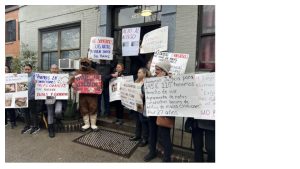
East Harlem tenants protest outside their building. They eventually won $133,000 in a lawsuit against their landlord and legally mandated repairs
One of my favorite projects was writing an article about an East Harlem tenant’s rights victory LSA played a major role in supporting. The apartment building had roughly fifteen families who were members of LSA programs, and their landlord had been neglecting repairs, leading to carbon monoxide leaks, rat and roach infestations, and collapsing infrastructure. I got to visit the building, interview the tenants, and take photos of the property, which was an eye-opening and critical experience. Hearing and seeing their stories firsthand brought the abstract issues of housing insecurity and tenant rights into harsh reality, and it made writing the article feel like a rewarding way to translate their victory into an accessible narrative.
Another highlight was the “Flavors of East Harlem” event LSA hosted in honor of its major donors and partners. The event was designed to give supporters a wide sampling of some of the best cuisine East Harlem has to offer, ranging from Mexican to Peruvian to New American food. Many of the restaurant owners were former clients who used LSA’s resources to acclimate to New York City, or current LSA donors, whose support made the event possible. I helped coordinate communications with these restaurateurs and assisted in event logistics, and set-up the physical layout on the day of. The event was a vibrant celebration of East Harlem’s cultural diversity, and a reminder of LSA’s lasting community connections (plus, a fellow intern and I got to go home with an entire leftover tres leches cake, which was delicious!).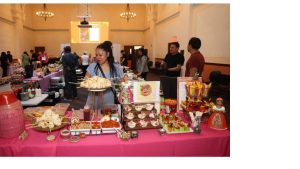
Overall, my experience at LSA not only allowed me to develop practical skills in nonprofit development and community engagement, but also gave me a profound appreciation for the resilience of the East Harlem community. I am grateful for the opportunity to contribute to an organization whose mission aligns so closely with my own values and heritage, and I plan to continue doing so moving forward regardless of where I end up.
My program managers Christian Carvajal, Melina Gonzalez, and (former Ram) Grace Ayres-Doyle provided me with excellent guidance, support, and encouragement throughout my internship. They each consistently gave clear feedback and instruction, and were always accessible and understanding. At the same time, they entrusted me with enough independence to demonstrate confidence in my abilities, which showed me a level of genuine respect that can be lacking towards interns at other organizations. Their collective support made this experience truly meaningful, and I’m glad to have been a part of the LSA family.