


When I first came to southern Arizona, I noticed the heat, the saguaros, and a sightline that extended dozens of miles across the Sonoran Desert. It was striking; a stark reminder of life’s fragility, often fragile by our own hand—frequently drained aquifers leave soil infertile, Border Patrol hunts people to death, and the city of Tucson creeps across the plain ever slowly turning dirt to concrete. As I returned to the desert this week, I was welcomed instead by storm clouds thousands of feet tall, depositing dangerous quantities of rain into the flood-prone valley cradling the twin cities of Nogales, AZ and Nogales, Sonora. I waited in line at the border watching as runoff crawled its way down the hills of Colonia Buenos Aires, slowly incapacitating an urban center of several hundred thousand people with floods.
The rain is a quotidian disaster—there are always missing people. And despite the aquifers being replenished during the monsoon season, the flooding humiliates the city and humbles its residents. On this particular afternoon the rain felt an appropriate backdrop to my first crossing in a year. As I pulled my truck into the inspection lane a Mexican solider, his patrol cap soaked, questioned me. I showed him my registration when I turned to see large white buses pulling alongside the port of entry. I did not yet know that they were packed with deportees; I only heard the clanking of chains as United States customs officers opened the doors.
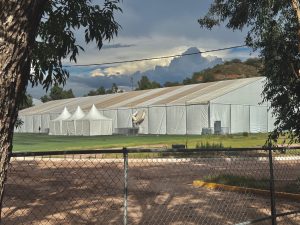
The Unidad Deportiva tent camp, which spans a full-size soccer field and is set up to process large groups.
Then came the line. Exclusively men, cuffed at the hands and each one nimbly holding a manila folder with documents of deportation were led forward. A young officer hardly older than I described in Spanish what was going to happen. They were going to be processed by Mexican authorities, loaded back onto other vehicles, and taken to a sports complex turned deportation camp at the Unidad Deportiva de Nogales. There, deportees are marked down, handed basic necessities, and set free with bus tickets to their final destinations—all the deportees that go through Nogales are Mexican nationals. Many choose to stay rather than go home—they left for a reason. And so, the streets of Nogales become lined with people; strangers and stranded.
Despite deportees being recorded and next of kin being contacted, the Mexican system for keeping track of deportees is insufficient and obscure. There is an obvious human cost: Nogales is controlled by cartels, who target vulnerable people now more than ever as their smuggling routes are sealed shut by international policing efforts. People continue to disappear, particularly women. Deported children are taken in by Mexican agencies such as DIF (Sistema Nacional para el Desarrollo Integral de la Familia) but will likely remain in temporary housing as their families are either out of reach, out of money, or dead.
A secondary effect is that many shelters, such as the Kino Border Initiative, whose mission for years revolved around care and attention for deportees, are left with empty beds and little to do—other than visits to the sports complex camp. And while there are many humanitarian groups and shelters along the path that the deportees may take, they will remain in the shadow of a transnational enforcement program that has radically changed the trajectories of Mexican and American culture and identity.
I was ushered through the inspection lane; the rain was still pouring down, and I was nervous about the floods. I didn’t turn to look, but I left the white buses—emblazoned with the logo and name of “Akima Global Services LLC” — behind. My passenger, a photographer who has been coming to Nogales for the last two weeks, let me know that there would be more buses the next day, and the day after, and again after that. Despite the circumstances, I sobered myself with the reminder that this is now and until further notice, what “ordinary” looks like in Nogales.