


In the summer of 2025, I had the opportunity to spend two months with Kino Border Initiative on behalf of Fordham University’s Initiative on Migrants, Migration and Human Dignity. Kino is a binational NGO in Nogales, Sonora, Mex., dedicated to providing humanitarian aid and holistic accompaniment to migrants. Kino offers meals, clothing, shelter, medical and psychological care, as well as legal assistance through Mexican legal aid and The Florence Project for U.S.-based cases. While there, I served meals, sorted donations, and supported daily operations. However, what impacted me most were the conversations I had with people navigating extraordinary circumstances. I met migrants from all walks of life, some recently deported and others nearing the final stretch of their journey. Most of them carry the hope of one day making it to the United States one way or another. Each person brought a story of resilience, strength, and hope.
Full-time staff and volunteers at Kino in Summer 2025
Under the new administration, the days at Kino had been very slow, with little to no migrants coming into the shelter. Recently deported migrants were no longer released at the border near Kino; instead, they were taken directly to Mexican government shelters in the center of Nogales. There, they were processed and moved within two to five days to Hermosillo, the capital of Sonora, before being sent either to their country of origin or farther south within Mexico. This rapid transfer system meant that many migrants were unaware of the services available at Kino and were forced to restart their journey from the beginning. This time, with no money, no belongings, and nothing to sell.
I remember working reception on the day a mother with five kids came in, looking nervous and scared. She was carrying a small toddler in her arm and her older kids ranged in age from five to thirteen. She was shy and afraid to trust her surroundings. I would later learn why.
Over the next five days, I became very close to her, as she began to feel comfortable enough to share her experiences with me and allow herself to be vulnerable. Linda is originally from Michoacán, the same state in Mexico as my parents. She fled for the safety of her children and herself due to cartel violence and domestic abuse. After lunch every day, I would open the computer lab, and Linda’s kids would take a moment to distract themselves from their situation while playing Roblox online and allowing themselves to be kids. During this time, Linda focused on her small toddler, and to help alleviate some of the stress, I often offered to hold David and put him to sleep. While he slept in my arms, Linda told me about how she had been displaced and forced to live on the streets in Nogales. She would sell candies on the street to help support her kids; many times, other street vendors denounced her for not having a vendor’s license. She searched for work wherever she could, but due to her housing status and the need to juggle childcare, steady employment was nearly impossible.
Linda also shared how difficult it had been to keep her kids in school while they were moving around. Each move meant they had to start over: new schools, new paperwork, new routines, and the constant uncertainty of whether they would be able to stay long enough to settle in. Many migrant children fall behind this way, not because they lack ability or motivation, but because the constant move makes education difficult. Still, Linda made it a priority. Her children loved learning, and even when her schedule made pickups challenging, she always found a way. What I admired most about Linda was her tireless efforts to always do what was best for her children, even if it meant sacrificing her own needs.
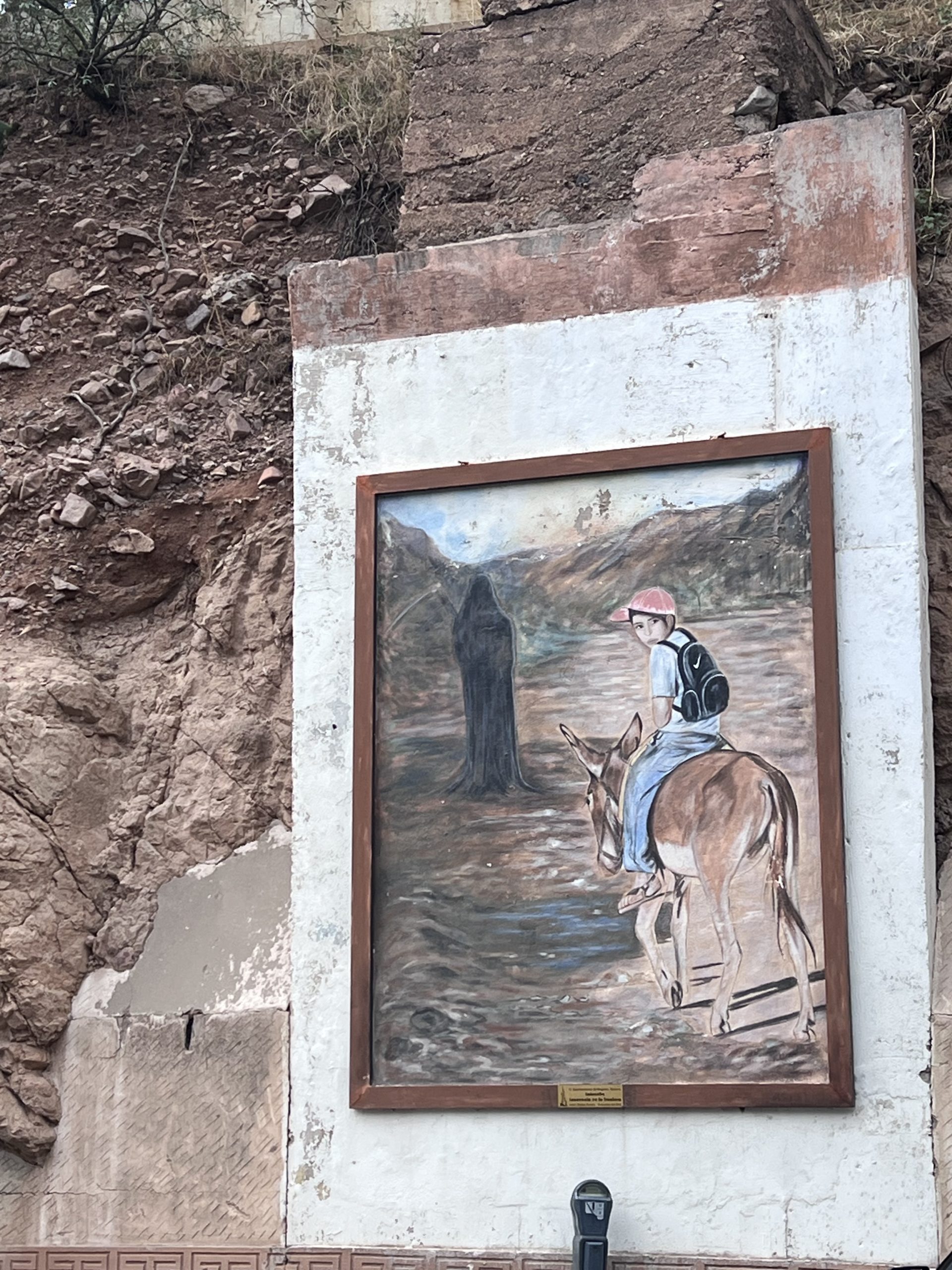
“Inocencia en la Frontera” by Ruben Daniels can be found on the Mexican side of the border wall in downtown Nogales. The painting reflects the loss of innocence that many kids carry with the uncertainty of migration and displacement.
Linda stayed in the shelter at Kino for a total of five days. She had received help from Kino to get a bus ticket to return to Zamora, Michoacán. Michoacán is a state deeply scarred by cartel violence. According to the Institute for Economics & Peace, Zamora ranked fifth most violent major municipality in Mexico in 2024 with over 101 homicides per 100,000 people, making daily life extremely dangerous (23). Linda discussed her fears of returning with me, but ultimately felt that it was the best choice for her children, as they were familiar with the area and could potentially reconnect with extended family. Before ending my shift that day, I made sure to say bye to Linda and her children. We group-hugged, and then Linda whispered in my ear, “Gracias por ser tan amable y por platicar conmigo.” “Thank you for being so kind and talking with me.” After that hug, I never saw or heard from Linda and her children again.
That moment with Linda stayed with me long after she left. It captures one of the most challenging aspects of migrant accompaniment: the emotional toll and uncertainty that come with saying goodbye without knowing what comes next. After leaving Kino, I felt a sense of helplessness. I spent two months at Kino, caring deeply for people, listening to their pasts and their plans for the future, and yet never knowing how the story would end. You don’t know whether the people you met found stability and safety. It makes you confront the limits of what you can do; you can offer kindness and dignity in the moment, but you can’t control the outcomes. Coming to terms with uncertainty has been one of the most challenging aspects of accompanying migrants. To this day, I still wonder if Linda feels safe.