


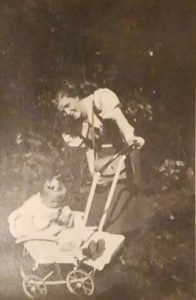
Author’s grandmother & father
As I took in the art and the creative energy bursting out of every square inch of the Casa de la Misericordia shelter in Nogales, Sonora—listening to stories of suffering and resilience and hope—my thoughts turned to my German grandmother who, in the icy winter of 1946, left her home near Gdansk, now part of Poland and began walking west, together with the 5-year-old who would become my father. And I wondered: Did she find a place along the way where she could rest, where someone offered her a kind word? Would her outlook on life have been more generous if she had?
As the campus rabbi at Fordham University and an immigrant myself, being able to join the Fordham Border Immersion Trip allowed me to reflect on my American and my Jewish identity in new ways. Hearing stories of migration firsthand, witnessing the sacred work of the Kino Border Initiative, and meeting volunteers like the Tucson Samaritans—people who show up, week after week, driven by a fierce commitment to justice—awed me and challenged me to think more deeply about my own responsibilities as a naturalized immigrant.
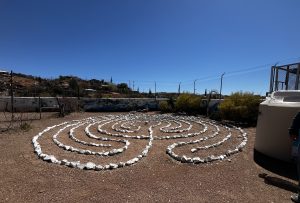
Garden at Casa de la Misericordia
The Hebrew Bible reminds us again and again to care for those who are different from us, the stranger, the resident alien, the migrant, what the Bible calls “ger,” a term also used for converts to Judaism. Perhaps the Torah recognizes that it is easier to love “thy neighbor as thyself” when they look and live like we do. And it pushes us: Love the stranger, too, whose culture or creed or way of life is unlike ours. Why? “For you were strangers in the Land of Egypt” (e.g. Vayikra/Leviticus 19:34). Our spiritual ancestors became migrants themselves when they left their homes under pressure, often to escape famine, to survive. And for many Jews today, those histories of migration and persecution still feel close to home. For me, the pictures coming out of a destroyed Gaza, and from an Israel where many remain displaced by war, make these demands even more urgent.
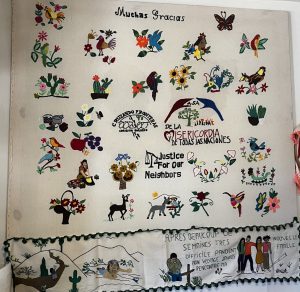
Embroidery made by migrants at Casa de la Misericordia
I do not know yet where the experiences of the Border Immersion Trip will lead me. But I know I am paying closer attention to news about ICE activities in my city, to rallies, to local organizing efforts. I connected with the Fordham Migration Initiative so I can stay informed and plugged in. I call my representatives. I give what I can. I think of my grandmother, who not once spoke to me about her life before the war, but who, every single month of the 68 years she lived in Germany, sent money to the one organization that had helped her.
And I return to the texts that give me language for what I am feeling: “Hear my prayer, O God, give ear to my cry; don’t ignore my tears, for I am a stranger with You, an immigrant like all my ancestors” (Psalm 39:13).