

We often overlook the similarities between things, for they can seem unremarkable. It is much easier to marvel at new places you haven’t yet seen, at new people you haven’t yet met, and at new ways of life you haven’t previously encountered. To overlook the similarities, though, would be to neglect the salient. At the same time, while loving what is unfamiliar can be difficult, growing and loving what appears that way at first glance rattles the very categories “similar” and “different” themselves.
I spent the summer of 2025 in Nogales, Sonora, Mexico, where I volunteered at Iniciativa Kino para la Frontera (Kino Border Initiative, or KBI) and Casa de la Misericordia y de Todas las Naciones (Mercy House, or Casa). KBI and Casa are migrant shelters only a few hundred feet and a few miles, respectively, south of the U.S.-Mexico border, near Nogales, Arizona. For all the thoughtful and unexpected ways I was directed and stirred to minister to migrants, I found my summer deeply moving. This summer disrupted and expanded my conceptions of similarities, differences, and love.
While working at KBI, I helped migrants find clothes that fit, clothes they could feel good wearing. In late June, I realized all the trips I was making to and from the bodega where clothes are stored mattered: presentation and dignity go hand in hand.
For hours on end during otherwise hot, lethargic afternoons, I played card games with children staying at KBI. Most often, I played with Ricardo and Irma, siblings who loved one another and loved to bicker. Spending afternoons with them, I learned to mediate card game-related squabbles, and I picked up several new Sonoran colloquialisms. I was also taking Ricardo’s and Irma’s minds off the looming unknown—where would they be come autumn? I was helping them be kids, free from questions big and scary for anyone, much less anyone their age, if only for a few hours.
I came to see that they were also giving me the gift of love by spending their afternoons playing cards with me; I was becoming undone in ways I could not yet articulate.
While working at Casa on my days off from KBI, I organized Casa’s communal pantry. This labor of love helped me grow in patience.
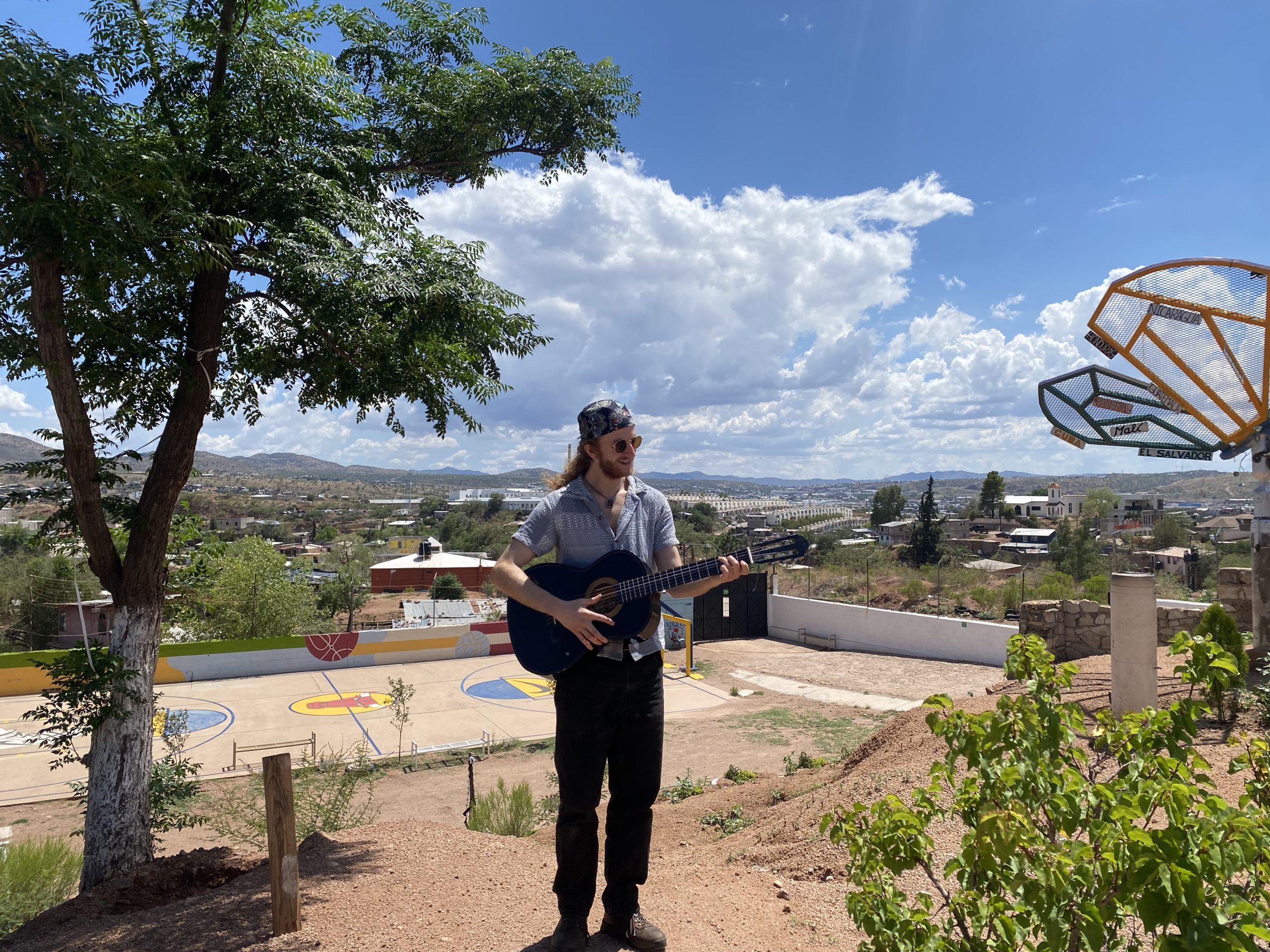
And on one of the afternoons when I was playing Casa’s acoustic guitar for the children staying there, a young girl asked me how to play the guitarra. While we watched the sky darken in the east, I showed her where to place her fingers on the third, fourth, and fifth strings so she could strum an A major chord.
Playing the guitar at Casa
Of course, encountering these new places, people, and experiences was meaningful. Immersing myself in the shelters, listening deeply to the stories people shared with me, and being present for all these experiences showed me different ways of being and knowing. Also instructive were the similarities I recognized between the people I knew and the people I met at KBI and Casa. These similarities were revelations, both sobering and heartwarming. More instructive than any of these supposed differences or similarities, however, were the new forms of love, dialogically forged visions of justice, and transformational experiences of interrelation I gleaned through my interactions with the people I met.
At KBI, I befriended a woman named Gabi who is from Guerrero, Mexico. I met her during breakfast in early June. Gabi enjoys boxing, soft pajamas, and reality television. Although our early exchanges were tentative and superficial, a connection soon formed, and I learned she also enjoys deep, meaningful conversations. When I wasn’t playing Egyptian ratslap with Ricardo and Irma on hot afternoons, Gabi and I soared through a whole galaxy of conversation topics, landing on Mexican-American politics and fusion cooking, our dreams for our futures and the futures of our two countries. We developed new insights and related to one another in more nuanced ways by sharing our stories, knowledge, and visions. Many of my most meaningful memories from this summer constellate around my afternoon exchanges with Gabi.
Though Gabi was in a transitional period when I met her—debating whether to stay in Nogales, return south to Guerrero, or head north to the United States—she encouraged me to take my time in life. “Poco a poco, se llega lejos,” she always said to me (“Little by little, you go far”). It is unlikely that I will see Gabi again in this lifetime, but I think of her often. Her mischievous, principled, contemplative, and kind spirit lives on in me.
Because of my friendship with Gabi, overlooked similarities surfaced, taking on great significance. Gabi’s playfulness and wisdom reminded me of the whimsy of my friends from New York. I began seeing my family and my hometown friends in the guests at KBI with whom I shared breakfast and lunch. I saw in Ricardo, Irma, and the children at Casa my nieces and nephews, who too are growing up fast in frightening times and are not always able to be just kids.
Further, and more instructively, because of my relationships with Gabi, Ricardo, and Irma, my previously held ideas about service and accompaniment gave way to a new, deeper understanding.
Of course, honoring the unique experiences, needs, desires, and personalities of migrants is integral to upholding their dignity. Like my nieces and nephews who were born and raised in the United States, I have lived a life so different from many of the people I met at KBI and Casa; comparing my lived experiences to theirs would demonstrate an imperious obliviousness to privilege, power, and difference. We uphold migrants’ dignity and can advance migration justice, however, when we recognize our differences and appreciate our similarities, it helps us humanize one another while destabilizing the a priori distance fabricated by the different identities imposed on and taken up by us. I learned from experience that people who have not migrated share numerous similarities with people who have. I suspect that this is something you recognize, too. We love the same card games and the same foods, and we ask the same deep, existential questions about the universe, ourselves, and each other. And we are all seeking the same thing: love.

Wood-panel artwork on KBI’s façade
I realized that love differentiates accompaniment from service, that love was the inevitable outcome of appreciating similarities, honoring differences, and letting encounters with similarities and differences destabilize my own relationship to myself and others. An act of service is a discrete convenience: it is something one does, abandons, and then resumes, but only when it fits in one’s schedule conveniently. Accompaniment, in contrast, is a continuous, reciprocal obligation. It is a blessing to be called to accompany another human being. Accompaniment does not rely on a power imbalance; it means we—with all our differences and similarities—can work together in solidarity, empower one another, and experience more love in our lives. With accompaniment, everyone has something to bring to the table. It is the essence of just politics, and its goal is its own obviation.
Love—both an appreciation of good-spirited differences and a compulsion born from seeing the humanity in one another—drives the profound way of being that is accompaniment. My summer in Nogales revealed to me this different, more beautiful, and more interconnected way of being.