

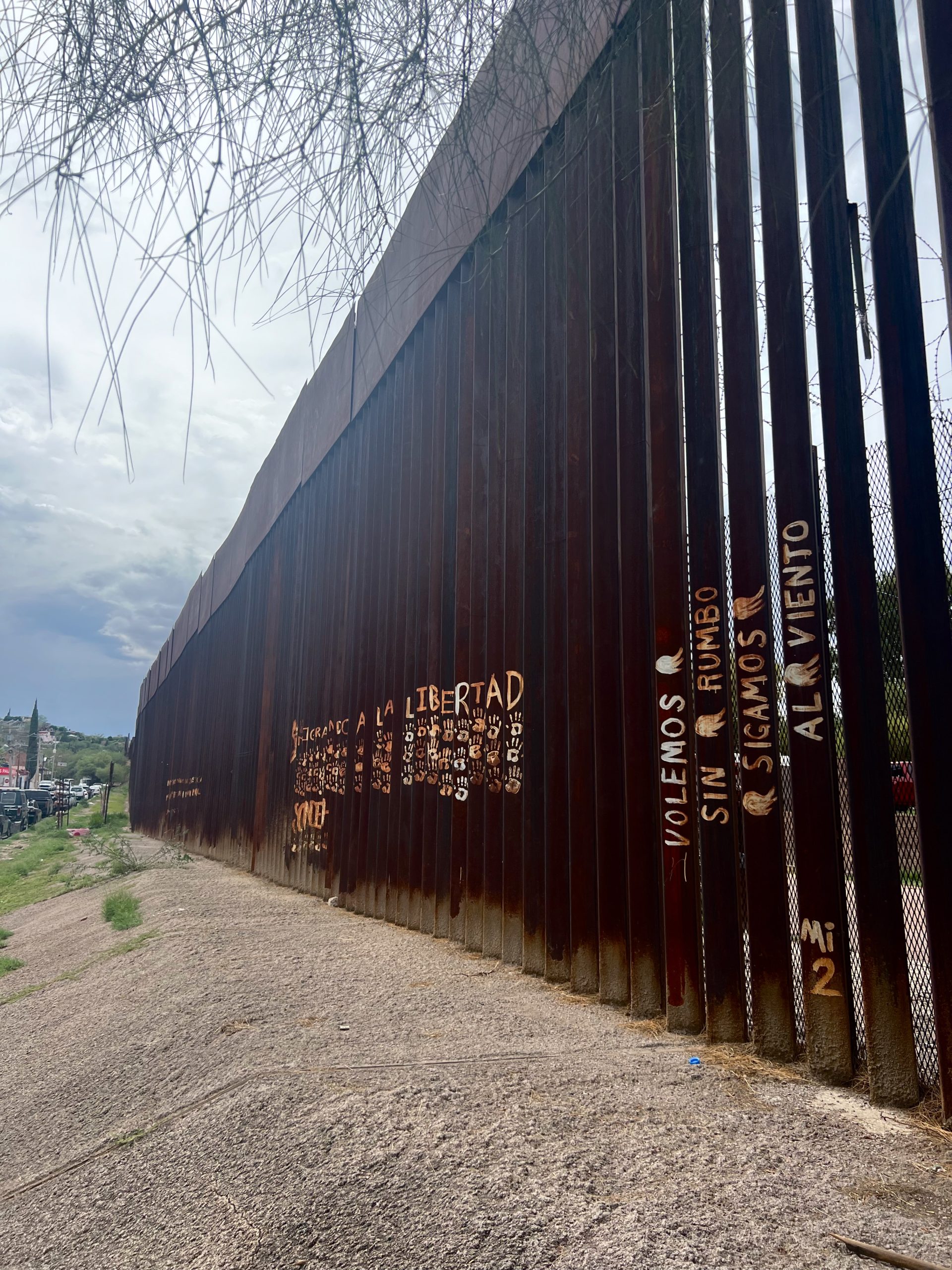
During the summer of 2025, I had the opportunity to spend two months in Nogales, Sonora, Mexico working at the Kino Border Initiative, a migrant shelter just a five minute walk south of the US-Mexico border. Within our first week of arrival, las Hermanas, the four nuns who worked at Kino, invited us to their home to have dinner and play Rummikub. We pulled up to their front gate, and when I looked down the road, I could see the 20-foot steel wall looming over the surrounding neighborhood. While I’d flown across the border many times, I had never been face to face with the wall itself, and I was struck by how divisive the structure truly is. Splitting Nogales cleanly in half, the message of the wall is clear: “Keep out.”
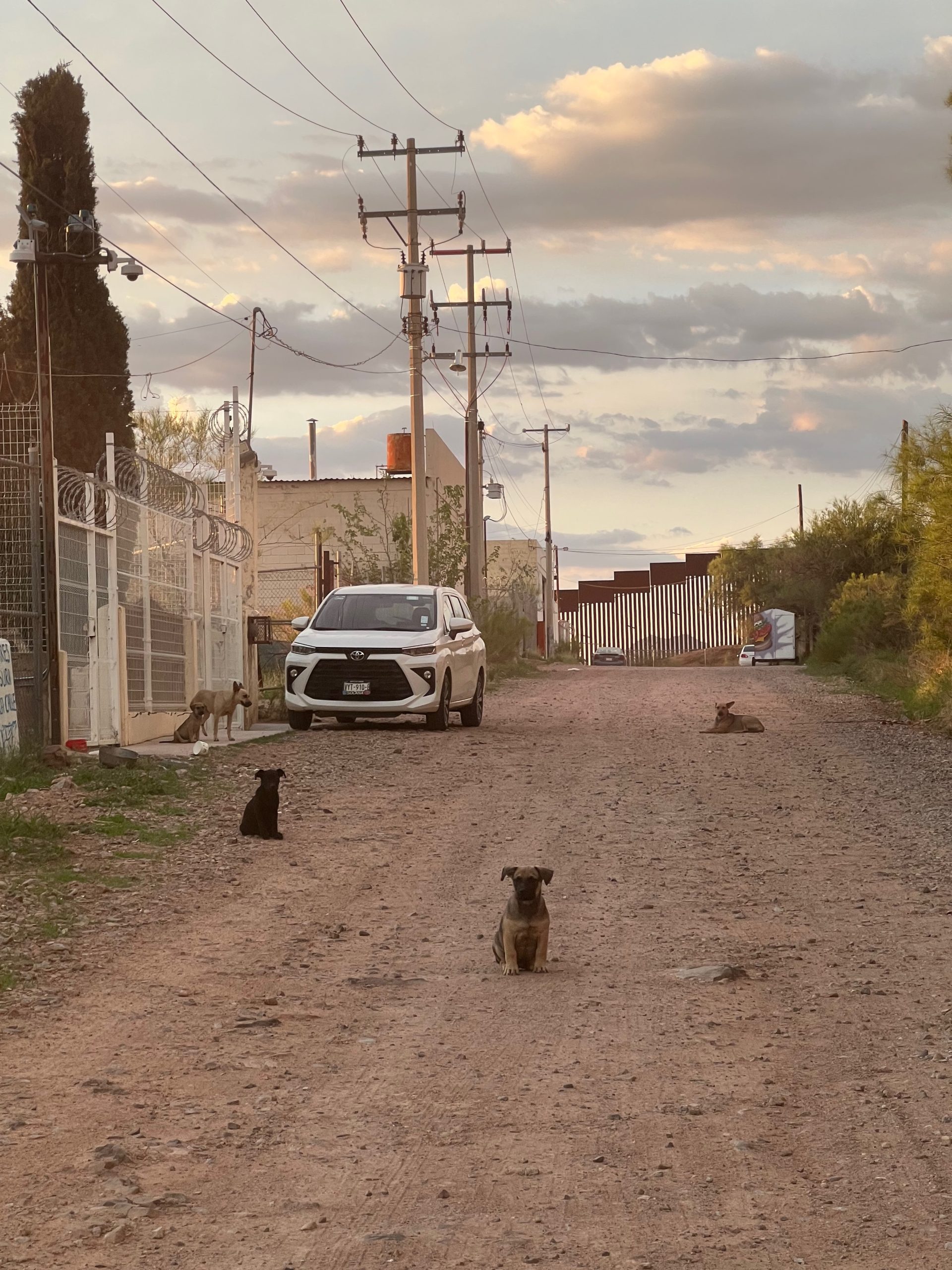
Road in Nogales, Sonora leading to border wall
While it may be easy to think of the wall as an intrinsic part of the border between the two countries, it hasn’t always been the imposing structure it is today. The original town of Nogales was called Ambos Nogales and it spanned both Arizona, USA and Sonora, Mexico. The boundary line was an international street where residents from either side could easily cross from one country to another. The first physical barrier built in Nogales was a six-string wire fence commissioned by mayor Felix B. Peñaloza in 1918, with the agreement that the U.S. could build their own parallel fence on the other side. Peñaloza’s goal was to direct people towards two official entry points, attempting to minimize confusion and conflict over border crossing (Rachel St. John, Smithsonian). Instead, as decades passed, tensions along the border increased and the wall came to embody the conflict that it had originally been erected to avoid. Now made of steel and concrete and standing at 20-30 feet, the wall is emblematic of the fear and hostility that keep the U.S. and Mexico apart.
However, the community I found at Kino embodied the communal nature of the original Nogales. With a mix of staff, volunteers, and migrants from all over the U.S., Mexico, and many other Latin American countries, Kino was a place of international coexistence and a celebration of difference. Whether I was chatting with the kitchen staff, playing with kids in the reception area, or even just working by myself at the front desk, the energy at Kino was lively and inviting. At the volunteer house where we lived, our conversations were a fluid mix of English and Spanish, moving from one language to another without hesitation. I was in the presence of people whose life experiences were completely different from my own, and yet I never once felt a barrier between any of us.
As volunteers, our days consisted of preparing food, sorting donations, giving out clothing, and scheduling people for appointments with the staff. Though we were given these tasks, our main job, as everyone at Kino often stressed, was “accompaniment;” the simple act of showing up and being there for the people that needed it. Whether someone wanted an opponent for a game of chess or a listening ear as they recounted their journey, the most valuable thing we could contribute was our presence. I shared meals with people from Mexico, Honduras, Guatemala, Ecuador, and many other countries, and learned about the hardships they had gone through just to make it to Nogales. I met individuals who had lived their entire lives in the U.S. but had recently been deported, with no family or friends left in Mexico to support them. Many of these same people had come from Oregon and Washington and were familiar with my hometown, Portland, OR. We bonded over our love of the Pacific Northwest, and I struggled with the knowledge that I could go home at any time, while they might never see those places again. Though these conversations were often heartbreaking, I was inspired by the migrants’ continuous hope and their faith that in the future, their situations would improve.
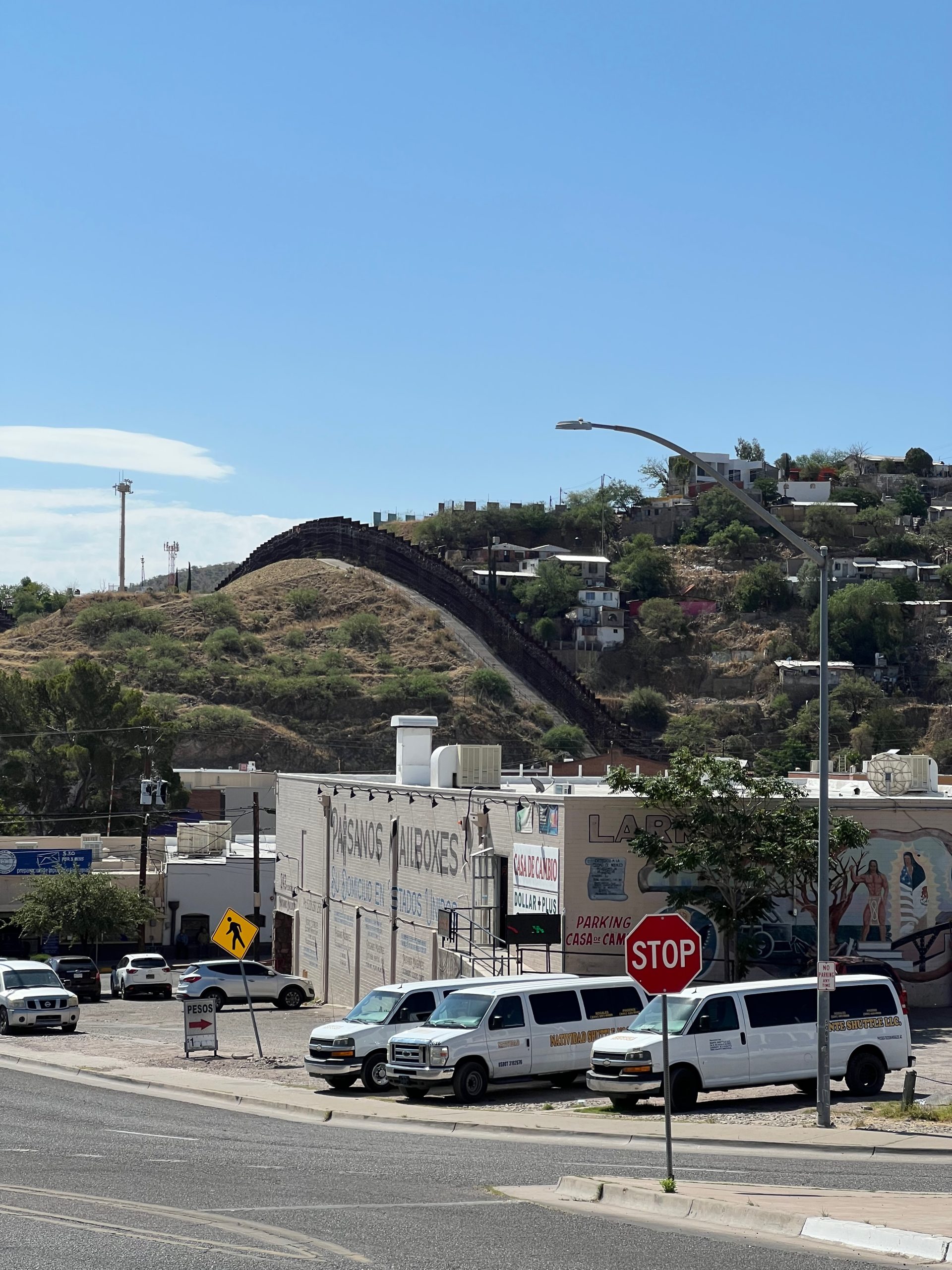
Border Wall as seen from Nogales, Arizona
On top of our day-to-day at Kino, we also participated in educational opportunities on both the Mexico and U.S. sides of the border. This included sitting in on a presentation at the Sierra Club, an environmental preservation organization, on the environmental impacts of the wall itself. The presenter, Erick Meza, explained how because of the wall, animals are unable to follow their natural migration patterns, inhibiting them from finding food and shelter from season to season. Additionally, the Center for Biological Diversity reports that division between regions can lead to genetic isolation, endangering reproduction rates for at-risk species such as jaguars and ocelots. Border wall construction threatens the few remaining wildlife corridors that allow these species to pass from one territory to another.
Meza also talked about the toll construction takes on the land itself, pointing out just how much gets destroyed during wall expansion efforts. The REAL ID Act of 2005 allows the Department of Homeland Security (DHS) to bypass any law in order to continue border wall construction, including the National Environmental Policy Act, Endangered Species Act, Clean Water Act, National Historic Preservation Act, and the Native American Graves Protection and Repatriation Act. Just this past April, Mount Kuchamaa, a mountain sacred to the Kumeyaay people, was dynamited in order to ease construction of the wall through the area. In May, DHS filed suit trying to claim Mount Cristo Rey and the surrounding land for border wall construction. The religious site, which hosts around 40,000 pilgrims a year, is a place of celebration and community. To build a barrier straight through would contradict the message of unity that Mount Cristo Rey upholds. The Sierra Club presentation concluded with a simple statement: “Migration is natural.” I believe this to be true for everyone and everything moving from one place to another. Coexistence, community, and change are natural parts of life—the wall is a physical manifestation of everything that inhibits this and keeps us apart.
View of wall from downtown Nogales, Sonora
My time at Kino impressed upon me how unnatural rigid borderlines truly are. Just as the wall disrupts the natural ecosystem of the land, it also disrupts migrant families and causes pointless hardship for those on either side. A border should be a place of convergence, where different things come together to form something new, yet the wall impedes the kind of coexistence that is necessary for a thriving ecosystem. Kino allows for a brief return to the communal environment of Ambos Nogales, celebrating migration as a natural part of life.